
This manual introduces the hardware overview, installation, use and communication of M850-MP1 multifunction meter
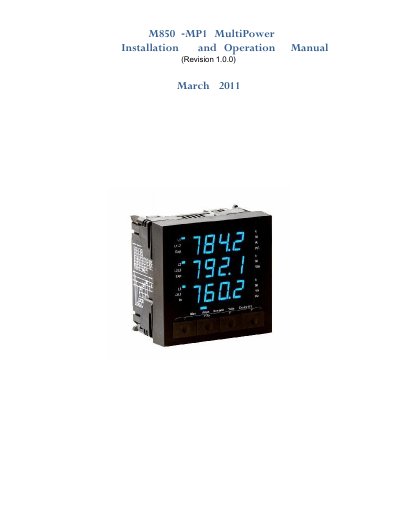
This manual provides step-by-step instructions for installing and operating the M850-MP1 MultiPower meter. It covers mechanical mounting, electrical connections, optional plug-in modules, and front-panel configuration. The meter is designed for single-phase and three-phase systems and features RS485 and pulsed output options for remote monitoring. It includes detailed specifications for voltage, current, and environmental conditions.
| Input Voltage Range | 28V to 330V (L-N); 48V to 600V (L-L) |
|---|---|
| Current Input Range | 0.5A to 6A via current transformer |
| Frequency | 45–65Hz standard; 400Hz available |
| Display | 3 lines, 9999, Blue LED |
| Brightness | User-adjustable for 8 levels |
| Accuracy (Voltage) | 0.5% of reading ± 2 digits |
| Accuracy (Current) | 0.5% of reading ± 2 digits |
| Auxiliary Voltage | 100 to 440V,AC / 100 to 420V,DC |
| Operating Temperature | 32°F to +140°F (0°C to +60°C) |
Yes, a 400Hz version is available.
The meter measures line-to-neutral voltages from 28V to 330V and line-to-line voltages from 48V to 600V.
The meter has an input overload rating of 800V AC continuous.
The unit requires 100 to 440V AC or 100 to 420V DC power systems.