
This manual describes the installation and use of the antenna.
This guide details the installation of Tekron’s GNSS antenna for industrial/static timing applications. It covers antenna placement to ensure clear satellite visibility, lightning protection methods including the use of a lightning arrestor, and cable installation best practices. The document also includes specifications for the antenna cable and lightning protection kit, such as operating temperature ranges and electrical performance metrics.
| Operating Temperature Range | -40 to +85 °C |
|---|---|
| Attenuation (1575.42MHz) | 32.80 ~ dB/100 m |
| Velocity of Propagation | 83% |
| Time Delay | 4.00 ~ ns/m |
| Impedance | 50 Ω |
| Capacitance | 79.8 pF/m |
| Shielding Effectiveness | >90 dB |
| DC Resistance Inner Conductor | 10.830 Ω/km |
| DC Resistance Outer Conductor | 12.760 Ω/km |
| Voltage Withstand | 1500 VDC |
| Jacket Spark | 5000 VRMS |
| Peak Power | 5.6 kW |
| Dimensions (Width) | 32.9 mm |
| Connector Type | N-Type Female (Both Ends) |
| Operating Temperature Range | -40 to +90 °C |
| Maximum RF Power @ 20oC | 30 W |
| Frequency | 1150 to 1610 MHz |
| Insertion Loss | 0.1 dB (Typical) |
| Surge (Max) | 30 kA |
| Surge (Max) Multi-strike | 20 kA, 8/20 µs (IEC61000-4-5) |
| Response Time | 10 ns |
| Through Current | 1 A |
The antenna should be installed in a position with a clear view of the satellites, avoiding obstructions like terrain, pylons, or mobile objects.
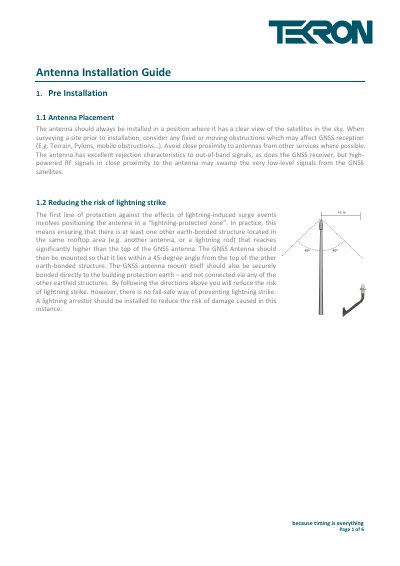
Install a lightning arrestor between the antenna and clock, and mount it on a conductive metal surface bonded to the building’s protective earth.
The absolute minimum bend radius for the antenna cable is 40mm, but a larger radius is preferable.
The operating temperature range is -40 to +85 °C.