
Liquid Controls Mechanical Air & Vapor Eliminators Installation and Operation Manual

This manual provides the technical details on installation, hardware, setup, operation, and regulatory information for your equipment
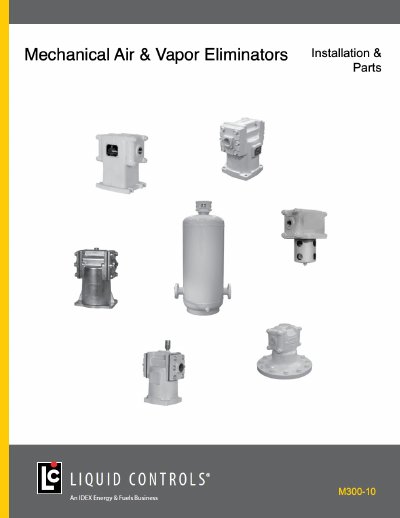

Liquid Controls Mechanical Air & Vapor Eliminators Installation and Operation Manual - cover page
Brand
Liquid Controls
Category
Industrial Supply
Document type
User Manual
Language
English
Pages
35
File format
PDF
File size
3.8 MB
Published
19 October, 2023
Updated
19 October, 2023
MD5 checksum
51E267AB4A3525D055E8C651B4C6FAF1

About this manual

Liquid Controls Mechanical Air & Vapor Eliminators are designed to remove air and vapor from metering systems to increase measurement accuracy. These devices are typically bolted onto the top of a strainer on the inlet side of the meter and must be piped to a storage tank and an air-check or differential valve. The eliminators operate by allowing air and vapor to rise into a cavity, pushing a float that seals the vent ports to prevent liquid from entering the storage tank.

What's inside

  • Safety Procedures
  • General Information
  • Orientation and Components
  • Air and Vapor Elimination
  • Air Check and Differential Valves
  • Limited Bleed Valve Plates
  • Installation
  • Maintenance

Frequently asked questions

What is the purpose of the Liquid Controls Mechanical Air & Vapor Eliminators?

They remove air and vapor from metering systems to increase meter accuracy by allowing only liquid to pass through.

How do air and vapor eliminators prevent liquid from entering the storage tank?

They seal off the pathway by using a float and reed strips to close the vent ports when liquid rises.

What is the size of the bleed hole in the valve plates?

It is 1/32-inch in diameter.

What torque value should be used when tightening terminal block screws?

Use 3.5 in • lb (0.4 N • m) torque.

Download PDF (3.8 MB)