
This is the user manual of Broox animal repellent RB-101. The device is charged by solar energy. When the device detects animals, it will emit ultrasonic waves to repel them.
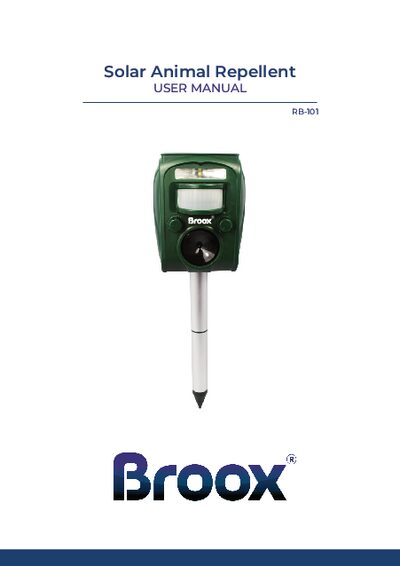
The RB-101 is a solar‑charged animal repellent that uses a passive infrared (PIR) sensor to detect motion and emit ultrasonic sounds, flashing LEDs, and alarm tones to deter various animals. After an initial USB charge, the device runs on solar power and offers five selectable modes with adjustable frequency and sensitivity.
The manual explains how to charge the unit, choose an optimal installation location, adjust the sensitivity and frequency knobs, and understand the technical specifications such as detection range, sensor angle, and IP44 weather rating. Safety notes and troubleshooting tips are also included.
| Infrared Sensor Angle | 110 degree |
|---|---|
| Detection Range | 6‑8 meters (20‑25 Feet) |
| Power Supply | Solar power + 3× Ni‑MH AA rechargeable batteries or 9V,1A adapter |
| Charging Light Indicator | RED while charging, BLUE when fully charged |
| IP Rating | IP44 |
| Mode 1 Frequency Range | 13.5 kHz–19.5 kHz |
The device offers five modes: three ultrasonic‑only modes with different frequency ranges, mode 4 adds flashing light and an alarm sound, and mode 5 combines ultrasonic sound with flashing light.
The sensor can detect motion from 6 to 8 meters (20‑25 feet), depending on the size of the animal.
It has an IP44 rating, meaning it operates properly under normal rain but should be protected from heavy rainstorms.