
The EC-1500+1550 User Manual introduces the working principle, installation, use and maintenance of toroidal conductivity sensors.
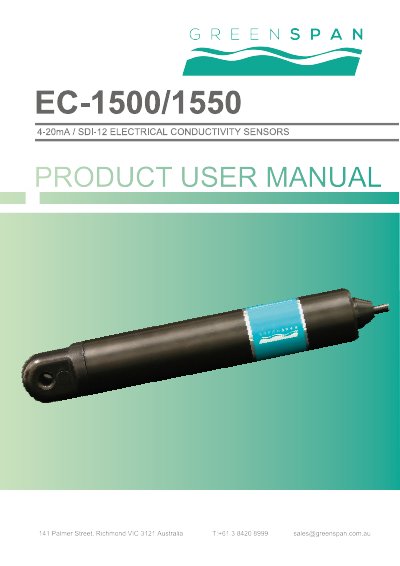
The EC-1500/1550 sensor is a fully submersible device designed for measuring water conductivity using a toroidal (inductive) method. This approach avoids direct contact with the liquid, making the sensor suitable for high conductivity applications and environments with high acidity. The device features no moving parts or serviceable components and is constructed from durable machined plastic and epoxy resins.
| Measurement Range | 0 to full scale |
|---|---|
| Output Unit | microSiemens per centimetre |
| Temperature Compensation | 2% per °C |
| Temperature Range | 0 to 50°C |
| Cable Diameter | 8mm |
It uses a toroidal method with two coils where conductive water increases magnetic coupling between them, rather than using electrical contact probes.
The compensation is set at approximately 2% per °C, adjusting the output as if the temperature were 25°C.
No, there are no serviceable components and no moving parts on the sensor.