
This manual provides IET Labs Model RV-722 voltage divider user and service information. It contains the same original esi Model RV-722 manual information along with more tutorials and background as well as instructions for the optional adjustment of the resistors.
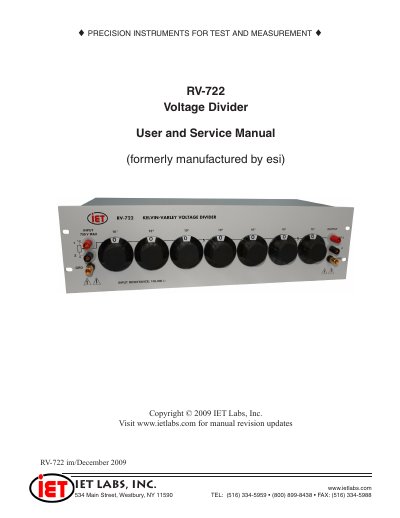
This manual provides instructions for operating and servicing the IET Labs RV-722 voltage divider, a precision Kelvin-Varley circuit used for calibration and bridge applications. It includes sections on installation, operation, resistor adjustment, and maintenance. The device features sealed switches and hermetically sealed resistors for long-term stability and can be adjusted to meet initial specifications.
The RV-722 is designed for high-accuracy voltage division with a resolution of 0.1 ppm and absolute linearity of 0.5 ppm. It is suitable for use in bridge circuits and high-impedance applications. Safety warnings are included for high-voltage operation, and the manual details calibration procedures and troubleshooting.
| Resolution | 0.1 ppm |
|---|---|
| Absolute Linearity | 0.5 ppm |
| Long-term Linearity | 1.0 ppm |
| Temperature Coefficient of Linearity | 0.2 ppm/ºC |
| Power Coefficient of Linearity | 1 ppm/W |
Yes, the RV-722 can be adjusted to meet initial specifications using the internal resistor adjustment procedure described in Chapter 5.
The resolution of the RV-722 is 0.1 ppm.