
This guide introduces the design, installation and related considerations of post-installed reinforcing bars.
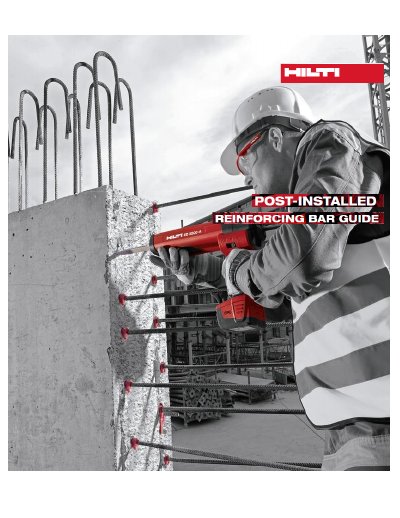
This guide explains how to design and install post-installed reinforcing bars to create monolithic connections between new and existing concrete. It covers design requirements, anchorage length, installation methods, and system selection. The guide also addresses compatibility with cast-in-place bars and includes design examples using Eurocode 2 and Hilti’s frame node concept.
Applications include structural extensions, strengthening, and bridge rehabilitation. Special tools and detection systems are recommended to avoid damage during drilling. Hilti adhesive systems are validated to match or exceed cast-in-place performance under tension loading.
They are used to emulate the behavior of cast-in-place reinforcing bars by anchoring adhesives in holes drilled in concrete.
The required embedment typically ranges from 40 to 60 bar diameters.
Reinforcing detection equipment such as the Hilti PS 250 or Hilti PS 1000 scanning systems should be used.