
The document introduces the clamping and manual forces of the clamping lever, including the mechanical principle, calculation method and table data.
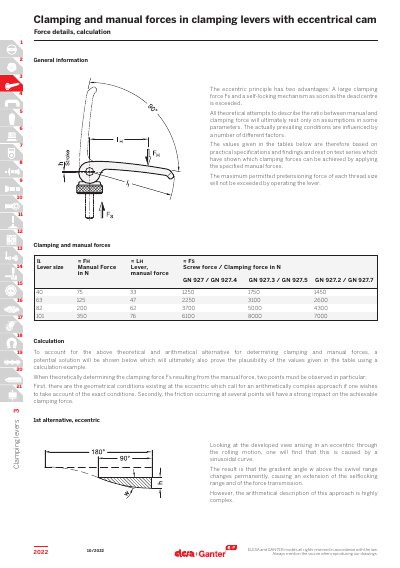
This document provides practical force calculation methods for ELESA and GANTER GN 927 series clamping levers. It includes tables showing manual force to clamping force ratios and a simplified substitute model based on wedge geometry. Friction coefficients and lever arm dimensions are specified for accurate calculations.
Safety factors are recommended for applications, with values ranging from 1.2 to 4 depending on load type. The document is based on test series and assumes standard conditions; users are advised to validate suitability for specific applications through their own testing.
| Manual Force (N) | 40, 63, 82, 101 |
|---|---|
| Clamping Force (N) | 1250, 2250, 3700, 6100 |
| Friction Coefficient (Plastic/Plastic) | 0.25 |
| Friction Coefficient (Steel/Steel) | 0.2 |
7000N, calculated using lever arms and friction coefficients.
1.2 to 1.5 for static loads.
0.15 for plastic/steel friction.