
This is a Wisconsin Department of Natural Resources Operator Certification Program Study Guide
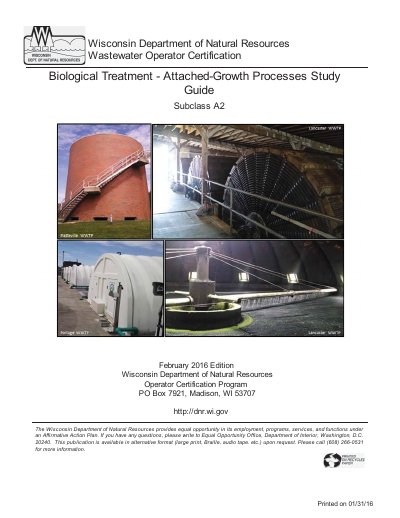
This study guide is designed to help wastewater operators prepare for the certification exam for Subclass A2, focusing on biological treatment using attached-growth processes. It covers key concepts such as microbiological principles, process operation, monitoring, safety, and calculations. The guide is structured by chapters and sections, each containing essential knowledge for exam success. It also serves as a reference for plant operations and includes definitions, operational methods, and troubleshooting guidance.
The guide emphasizes understanding environmental factors affecting microbial growth, including oxygen, temperature, pH, and nutrient availability. It explains processes like nitrification and denitrification, and describes equipment such as RBCs, trickling filters, and MBBRs. Diagrams and references are included for educational purposes but do not constitute endorsement.
It is an important resource for preparing for the certification exam and serves as a wastewater treatment plant operations primer.
Microorganisms convert dissolved and particulate organic matter, measured as biochemical oxygen demand (BOD), into cell mass.
Most microorganisms perform best under moderate temperatures ranging from 10°C to 25°C.
Most microorganisms function well in a pH environment between 6.0 and 9.0.