
Platypus Level and Pressure Measurement System Installation Guide

The document is about the installation guide of Platypus liquid level sensors. It introduces the structure and installation methods of Platypus liquid level sensors.
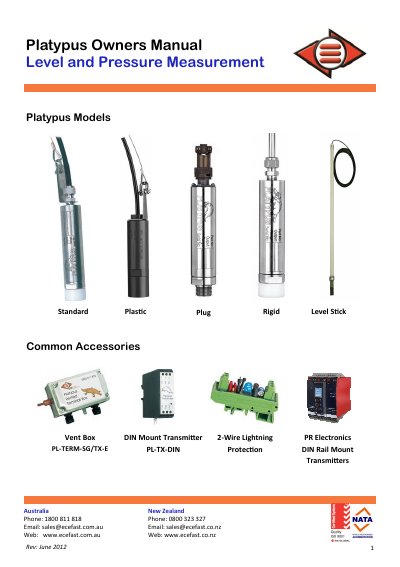

Platypus Level and Pressure Measurement System Installation Guide - cover page
Brand
platypus
Category
Other Electronics
Document type
Installation Guide
Language
English
Pages
8
File format
PDF
File size
1.2 MB
Published
18 October, 2023
Updated
18 October, 2023
MD5 checksum
5E2B616124A4E2ABCAE016DF1D72F450

About this manual

The Platypus system uses a gauge type sensor referenced to atmospheric pressure. Proper installation requires terminating the cable end to maintain this reference while protecting it from moisture. Mechanical considerations include using the supplied stainless steel support wire for submersible versions and avoiding pressure spikes or freezing conditions that could damage the delicate diaphragm.

What's inside

  • Platypus Mechanical Considerations
  • Cable Termination and Enclosures
  • Support Wire Usage
  • Pressure Spike Protection
  • Electrical Considerations
  • 4 Wire Output Configuration
  • Internal 4-20mA Transmitter
  • Cable Colour Code
  • Grounding and Lightning Protection

Frequently asked questions

How should the cable end be terminated?

The cable end must be terminated so that it is open to the atmosphere but protected from moisture ingress.

What is required for installing the PLATYPUS in high humidity locations like reservoirs?

It is mandatory to terminate the cable in an enclosure such as the PL-TER-MD-SG/TX-E to protect against moisture ingress.

When is the stainless steel support wire required for the PLATYPUS?

The support wire must be used for submersible versions, or when the cable length exceeds 20m or the unit is subject to turbulence.

What is the maximum resistance allowed for the ground connection on the stainless steel support wire?

The support wire must be connected to ground with a maximum resistance of 1 ohm for lightning protection to be effective.

Download PDF (1.2 MB)