
This manual introduces the use of ICC ASD-G9ETH Multiprotocol Ethernet Interface, including the installation, connection and configuration of the interface.
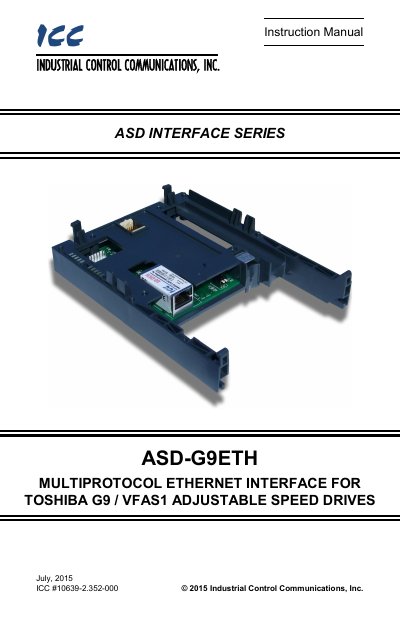
The ICC ASD-G9ETH is a multiprotocol Ethernet interface that installs directly into the enclosure of Toshiba G9, P9, H9, Q9, VFAS1, and VFPS1 Adjustable Speed Drives (ASDs). It provides a standard 10/100BaseT Ethernet port to transfer information between the drive and various fieldbus networks with minimal configuration. The interface supports multiple simultaneous protocols including Modbus/TCP, EtherNet/IP, Allen Bradley CSP, BACnet/IP, and PROFINET IO.
| Ethernet Port Standard | IEEE 802.3 10 BASE-T /100BASE-T X Ethernet compliant |
|---|---|
| Connector Type | Shielded RJ45 connector |
| Cable Type | CAT5-type 8-conductor unshielded twisted-pair (UTP) patch cables |
| Supported Protocols | Modbus/TCP, EtherNet/IP, Allen Bradley CSP, BACnet/IP, PROFINET IO |
| Operating Temperature | -10 ∼ +50°C (+14 ∼ +122°F) |
| Storage Temperature | -40 ∼ +85°C (-40 ∼ +185°F) |
The interface is designed for the Toshiba G9, P9, H9, Q9, VFAS1, and VFPS1 families of Adjustable Speed Drives.
It supports Modbus/TCP, EtherNet/IP, Allen Bradley CSP, BACnet/IP, and PROFINET IO. Note that PROFINET IO is mutually exclusive of the other supported protocols.
Communication cables must be routed separately from high-voltage or noise-emitting cabling, such as ASD input/output power wiring.