
PDL 800-B is a nanosecond pulsed diode laser that can be used for various scientific research and industrial applications
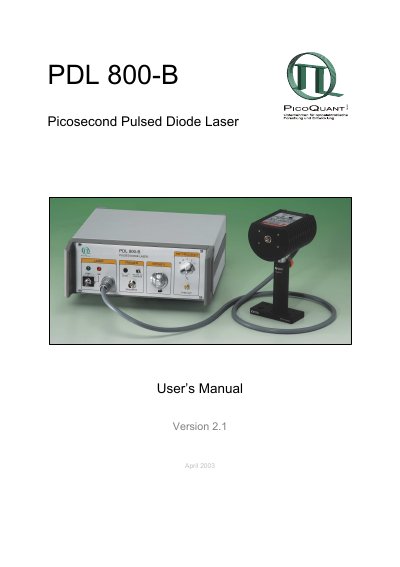
This manual describes the PicoQuant PDL 800-B, a driver unit for picosecond pulsed diode lasers and sub-nanosecond pulsed LEDs. It details the system's capabilities, including peak powers up to 1 Watt and pulse widths as short as 50 ps, along with various repetition frequencies.
The document provides comprehensive instructions on safety, installation, and operation. Key sections cover the user interface controls, electrical connections, heat dissipation requirements for different laser head models, and application tips for synchronizing with other instruments like TCSPC electronics.
| Peak Power | up to 1 Watt |
|---|---|
| Pulse Width | as short as 50 ps (FWHM) |
| Repetition Rate | single shot up to 80 MHz |
| Internal Clock Frequency | 40 MHz (standard) |
| Selectable Frequencies | 40, 20, 10, 5 or 2.5 MHz |
The driver is designed for LDH Series picosecond pulsed diode lasers, LDH-C Series cooled picosecond pulsed diode lasers, and PLS Series sub-nanosecond pulsed LEDs.
The laser can be triggered by an internal oscillator or by an external trigger input signal.
It allows the PDL 800-B to trigger other devices such as TCSPC electronics.