
This manual introduces the operation and maintenance of CryoMac3 50 GPM LNG nozzle
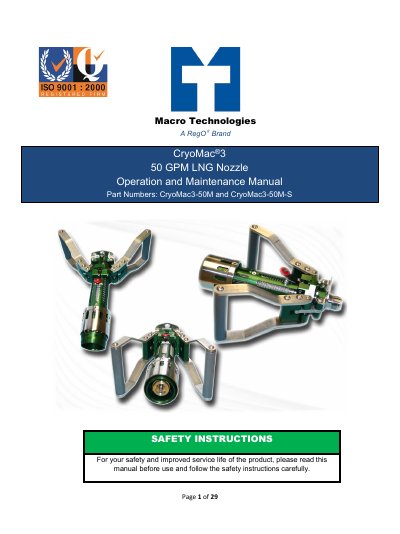
The document serves as an operation and maintenance guide for the Macro Technologies CryoMac3 50 GPM LNG Fueling Nozzle (Part Numbers: CryoMac3 -50M and CryoMac3- 50M-S). It outlines critical safety precautions regarding Liquefied Natural Gas (LNG) handling, including required personal protective equipment like full face shields and thermal gloves. The manual details the nozzle's key features, such as its positive 'Vent Position' for gas release and ball bearings for smooth operation.
| Maximum Refueling Pressure | 500 PSIG / 34.5 BAR |
|---|---|
| Burst Pressure | greater than 1,500 PSIG / 103.5 BAR |
| Rated Flow | 50 GPM @ 250 PSIG (LNG) |
| Nozzle Weight | 10.4 LBS |
| Port Size | 1" Male SAE 37 ° Flare (SAE J514) |
| Operating Temperature | - 320°F to +140°F / - 195°C to 60°C |
Operators must wear a full face shield, thermal gloves approved for cryogenic use, a cryogenic smock, and solid shoes capable of withstanding cryogenic spill.
The three handle positions are Connected, Vent, and Open (Connect/Disconnect).
Before fueling, use dry compressed air or nitrogen to blow out all water and frost buildup from the interior/exterior of the retaining ball area, slots behind the sleeve, and the male receptacle.