
This document is a guide to the selection of RakeMax® Multi-Rake Screens by Huber Technology, Inc.
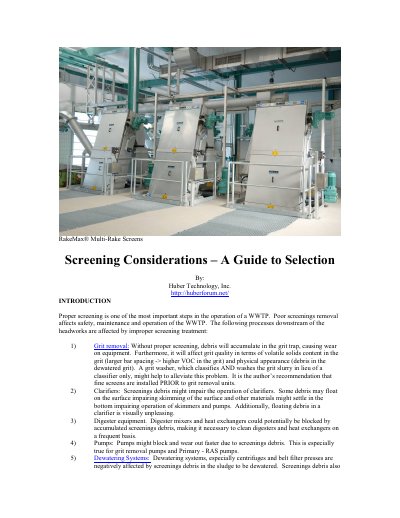
This document serves as a selection guide for RakeMax® Multi-Rake Screens and other fine screening technologies used in Wastewater Treatment Plants (WWTP). It details the operational importance of proper screening to protect downstream equipment like grit removal units, clarifiers, digesters, pumps, and dewatering systems. The text emphasizes that there is no single 'one size fits all' solution and outlines key factors for selection, including plant flow rates, required capture rates, headloss constraints, and disposal costs.
| Dry solids content of discharged screenings | at least 35% |
|---|---|
| Volume and weight reduction | at least 60% |
| Approach velocities for screen channels | 2fps (0.6m/s) to 3.3fps (1 m/s) |
| Max drum diameter for ROTAMAT Rol | 3m or 10ft |
| Available bar spacing for ROTAMAT Rol | 3/8" or 14" |
| Max drum diameter for ROTAMAT Ro2 | 10ft (3m) |
| Available bar spacing for ROTAMAT Ro2 | from 44" to 1/100" |
| Open surface area for clean Step Screen (2mm lamellas) | 75% |
Proper screening prevents debris from accumulating in grit traps, impairing clarifier operation, blocking digester equipment, damaging pumps, and negatively affecting dewatering systems.
Screen channels should be designed for approach velocities between 2fps (0.6m/s) and 3.3fps (1 m/s).
It should have full stainless steel construction, be fully enclosed to contain odors, achieve at least 35% dry solids content, and provide volume and weight reduction of at least 60%.
Typically, at least two mechanical screens should be installed so that one unit can be taken out for service or maintenance.