
The EFHW antenna is one of the oldest antenna designs in amateur radio. EFHW stands for “End Fed Half wave” and was first introduced way back in 1927 by the Austrian radio amateur, Dr. Josef Fuchs, OE1JF. Later the antenna got name “Fuchs Antenna.” It was patented in 1928, published in QST magazine and subsequently forgotten for many years. Today, amateur radio operators are often reintroduced to EFHW antennas thanks to high ratio wideband UNUN transformers wound on a ferrite core material. This allows the simple half wavelength long wire to instantly become a multiband antenna with reasonable match producing low VSWR values within bands. Beginning in 2015, the designer of high power MEF transformers (Multiband End Fed), Daniel “Danny” Horvat, E73M (aka N4EXA) has made number of huge advancements in designing of high ratio (49:1, 56:1, 75:1 and 81:1) UNUN (UN-balanced to UN-balanced) transformers and antennas. The efficiency- Insertion loss of the transformers continues to be unmatched by any copycat or competitor products on the market. These products made by EuroXpress Corporation use leading edge technology and materials, and are tested and verified to have excellent performance and reliability.
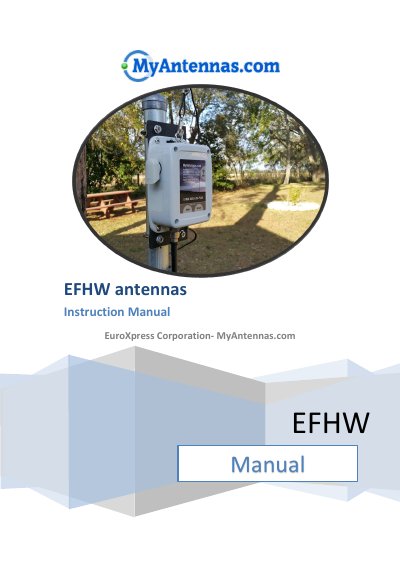
The document serves as an instruction manual for the EuroXpress Corporation's EFHW (End Fed Half Wave) antennas. It explains that these antennas utilize high-ratio UNUN transformers to function effectively on multiple amateur radio bands, a design originally introduced by Dr. Josef Fuchs in 1927.
The guide covers practical installation advice, emphasizing that antenna height and distance from objects are critical for efficiency. It details various wire configurations such as straight horizontal, Inverted L, Lazy L, Inverted V, Inverted U, and Sloper setups. Additionally, the manual provides specific instructions on grounding practices to prevent electrostatic discharge (ESD) and RF interference.
The manual recommends a minimum height of 20 feet at any or all points of the EFHW-8010 antenna models.
For Inverted L configurations, the vertical side starting at a minimum of 3 feet above ground should be at least 20 feet long.
You should avoid placing the lower side of a sloper at heights of less than 10 feet (3 meters) above ground.