
This document describes the conditions for replacing brake drums and rotors
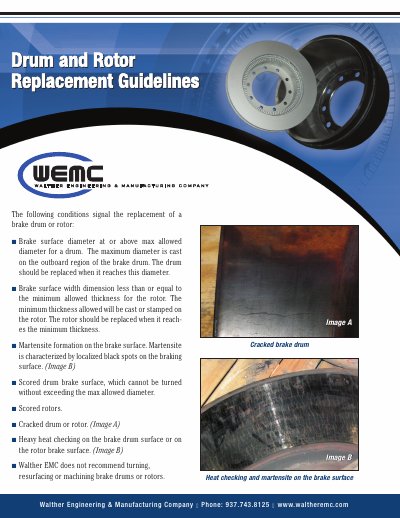
The document details the conditions under which a brake drum or rotor should be replaced. Key indicators include reaching maximum diameter limits, falling below minimum thickness, presence of martensite formation, scoring that cannot be machined out, cracks, or heavy heat checking. Walther EMC explicitly advises against turning, resurfacing, or machining these components.
A brake drum should be replaced when the surface diameter reaches the maximum allowed diameter cast on its outboard region.
A rotor should be replaced when the brake surface width dimension is less than or equal to the minimum allowed thickness cast or stamped on it.
No, Walther EMC does not recommend turning, resurfacing, or machining brake drums or rotors.
These assemblies use Grade 8 hex bolts or Grade 8 flanged hex bolts.