
This document introduces the application of near-infrared spectroscopy (NIR) technology in the pharmaceutical and chemical industries using the Swiss Metrohm NIRsystems NIR spectrometer. NIR spectroscopy is a versatile analysis technique known for its fast and non-destructive analysis. It has been widely used in various industries. In the pharmaceutical industry, NIR analysis technology has been successfully applied for many years, initially mainly for raw material analysis. With development, the focus of NIR applications has shifted to drug production processes, including solid and liquid formulation quality analysis and process control (IPC). NIR spectroscopy is the most commonly used method in the pharmaceutical industry to meet PAT requirements. In the chemical industry, NIR spectroscopy can play a significant role in quality control of chemical product manufacturing processes and solvent recovery. The advantages of NIR spectroscopy include significantly reducing analysis time, no sample pretreatment required, and simultaneous detection of multiple parameters.
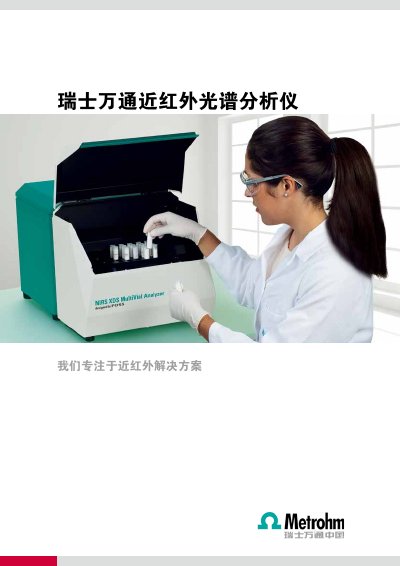
This document provides an overview of the Metrohm NIRsystems near-infrared (NIR) spectroscopy solutions. It highlights the advantages of NIR technology, such as rapid, non-destructive analysis, and its widespread use in industries like pharmaceuticals, chemicals, petrochemicals, and polymers for quality control and process analysis.
The guide details various instrument models including the XDS Series, DS2500, RCA, RSA, MultiVial, MasterLab, RLA, SmartProbe, IOPA, and TOPA. It explains different measurement methods (diffuse reflectance, transmission, etc.) and describes the specific sampling modules and configurations suitable for analyzing solid, liquid, and gel samples. This manual is written in Chinese.
| Wavelength Range | 400 nm - 2,500 nm |
|---|---|
| Max Temperature Control (RLA) | 65°C |
| Max Temperature Control (TOPA) | 200°C |
NIR spectroscopy offers rapid analysis (seconds), requires no sample preparation, and allows for non-destructive analysis.
The systems are used in pharmaceuticals, chemicals, petrochemicals, polymers, wood/paper, textiles, and printing.
Yes, the system complies with USP, Ph. Eur., and JP requirements and includes software for performance qualification tests.