
The document describes the features and characteristics of the ACS302-5T3 three-line AC switch array.
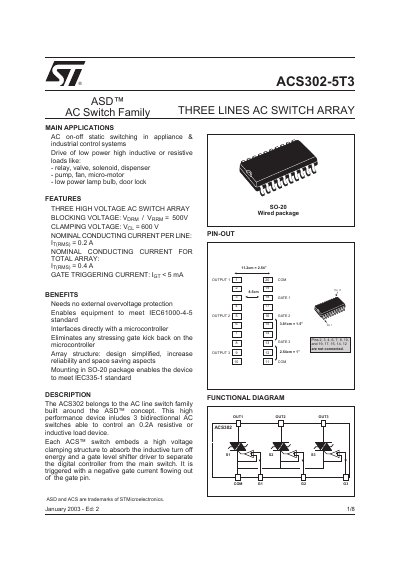
The ACS302-5T3 is a high-performance AC switch array from the ASD™ family, designed to control three bidirectional AC switches simultaneously. It is intended for use in appliance and industrial control systems to drive low-power loads such as relays, valves, solenoids, pumps, fans, and door locks. The device features an integrated high-voltage clamping structure to absorb inductive turn-off energy, eliminating the need for external snubbers.
| Blocking Voltage (Vopr / Varm) | 500 V |
|---|---|
| Clamping Voltage (Vc) | 600 V |
| Nominal Conducting Current per Line (IT(RMs)) | 0.2 A |
| Nominal Conducting Current for Total Array (lt(RMs)) | 0.4 A |
| Gate Triggering Current (lat) | << 5mA |
| Package Type | SO-20 |
The ACS302 is adapted for washing machines, dishwashers, tumble driers, refrigerators, water heaters, and cookwares to switch low-power loads like solenoids and valves.
No, the device needs no external overvoltage protection because it includes an embedded high voltage clamping structure.
Yes, it interfaces directly with a microcontroller and eliminates any stressing gate kick back on the controller.