
The TSC102 is a high-performance, high-voltage, low-power analog circuit that is used to measure small differential voltages on high-side shunt resistors in applications such as battery chargers, automotive current monitoring, notebook computers, DC motor control, photovoltaic systems, precision current sources, uninterruptible power supplies, and high-end power supplies.
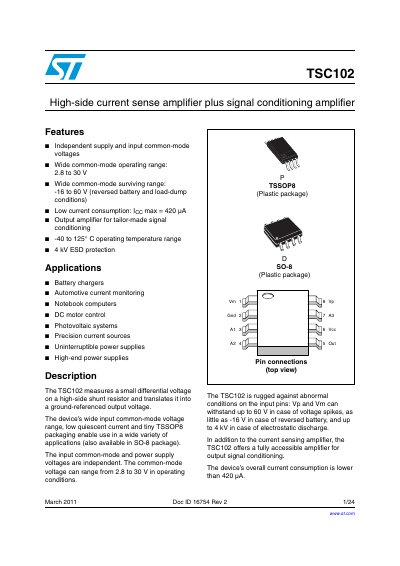
The document describes the TSC102, a high-side current sense amplifier featuring an independent input common-mode voltage range of 2.8 to 30 V. It includes a built-in output amplifier for signal conditioning and is designed for applications such as battery chargers, automotive current monitoring, and DC motor control.
| Input common-mode voltage range | 2.8 to 30 V |
|---|---|
| Operating temperature range | -40 to 125 °C |
| Total supply current (typical) | 420 µA |
| ESD protection (Human Body Model) | 4 kV |
The typical total supply current is 420 µA when pin A1 is open and pin A2 is shorted to Gnd.
The input pins can withstand a differential voltage of +20 V.
The signal conditioning amplifier has a typical gain bandwidth product of 1 MHz at f=100 kHz.