
NC7NZ14 TinyLogic UHS Inverter with Schmitt Trigger Input is a triple Inverter with Schmitt Trigger input from Fairchild’s Ultra High Speed Series of TinyLogic. The device is fabricated with advanced CMOS technology to achieve ultra high speed with high output drive while maintaining low static power dissipation over a very broad VCC operating range.
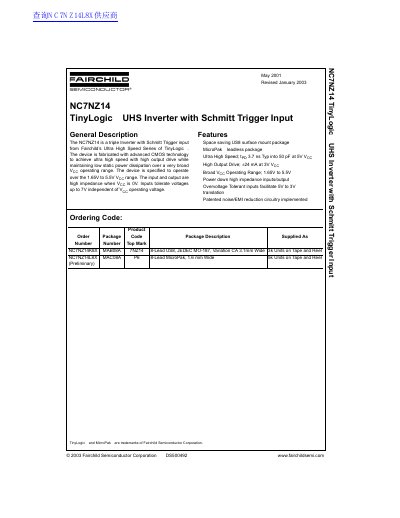
The document describes the NC7NZ14, a triple inverter featuring Schmitt Trigger inputs designed for ultra-high speed operation. It is fabricated using advanced CMOS technology to maintain low static power dissipation over a broad operating voltage range of 1.65V to 5.5V.
Key features include high output drive capability (up to +24 mA at 3V), tolerance for input voltages up to 7V independent of the supply, and patented noise/EMI reduction circuitry. The device is available in space-saving US8 surface mount packages or MicroPak leadless packages.
| Supply Voltage (Vcc) Range | 1.65V to 5.5V |
|---|---|
| Input Voltage Tolerance | up to 7V |
| Propagation Delay (Typical) | 3.7 ns |
| High Output Drive Current | +24 mA |
| Operating Temperature Range | -40°C to +85°C |
The device operates over a broad Vcc range from 1.65V to 5.5V.
Yes, inputs can tolerate voltages up to 7V regardless of the operating voltage.
The typical propagation delay is 3.7 ns into a 50 pF load at 5V.