
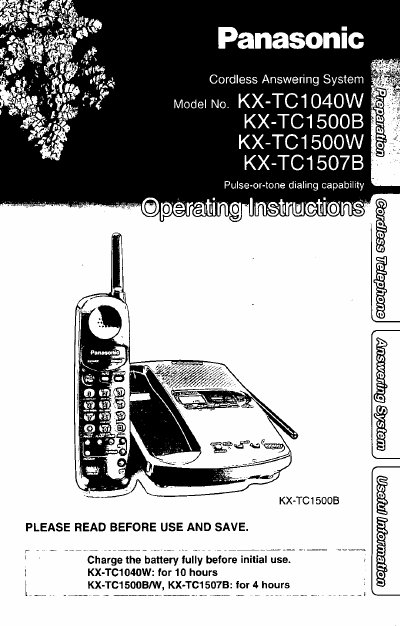
Panasonic KX-TC1040W/KX-TC1500B/KX-TC1500W/KX-TC1507B Manual


Panasonic KX-TC1040W/KX-TC1500B/KX-TC1500W/KX-TC1507B Manual - cover page
Brand
Panasonic
Category
Telephone
Document type
User Manual
Language
English
Pages
56
File format
PDF
File size
962 KB
Published
07 August, 2012
Updated
23 August, 2012
MD5 checksum
98AE7AE88E2F01768B1B22A12290B0B2

About this manual

This document is the user guide for the Panasonic KX-TC series of cordless answering systems. It covers initial setup steps such as fully charging the Ni-Cd battery before first use and selecting optimal base unit locations to ensure noise-free wireless operation between the handset and base. The guide details how to make and answer calls, store phone numbers in memory, and utilize speed dialing functions.

What's inside

  • Location of Controls
  • Battery Charge
  • Selecting the Dialing Mode
  • Preparing the Answering System
  • Greeting Message
  • Making Calls
  • Answering Calls
  • Storing Phone Numbers in Memory
  • Automatic Security Code Setting
  • Important Safety Instructions

Specifications

Battery Typerechargeable Ni-Cd battery
Initial Charge Time (KX-TC1040W)10 hours
Initial Charge Time (Other Models)4 hours

Frequently asked questions

How long should I charge the battery before initial use?

Charge the KX-TC1040W for 10 hours and the KX-TC1500B/W or KX-TC1507B for 4 hours.

How long must the battery be charged before initial use for each model?

The KX-TC1040W requires a 10-hour charge, while the KX-TC1500B, KX-TC1500W, and KX-TC1507B require a 4-hour charge.

What is the recommended location for the base unit to ensure noise-free operation?

Place the base unit away from electrical appliances like TVs or computers and in a high, central location with no obstructions such as walls.

What temperature range is safe for operating this cordless telephone?

Do not place the unit in a room where the temperature is less than 5°C (41°F) or greater than 40°C (104°F).

Download PDF (962 KB)

More Panasonic Manuals


View all Panasonic manuals →