
This application note introduces ST's mixed wire bonding technology and its advantages for automotive smart power ICs. The technology uses a mixture of gold and aluminum wires to allow ICs to carry currents of up to 20A while maintaining reliability.
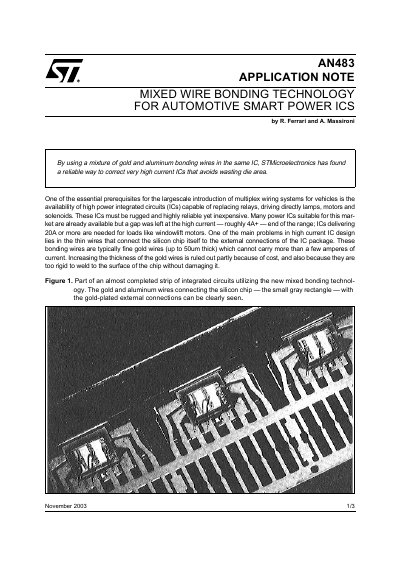
STMicroelectronics has developed a reliable method for creating high-power integrated circuits (ICs) suitable for automotive applications, such as window lift motor drivers. The solution addresses the limitations of standard thin gold wires, which cannot carry high currents without excessive cost or damage to the chip surface.
The technology utilizes a combination of thin gold wires and thick aluminum wires within the same IC package. Gold wires are used for low-current connections via thermosonic bonding, while thicker aluminum wires handle power connections using ultrasonic bonding. This approach allows for higher current ratings (up to 20A or more) without wasting valuable silicon die area.
It allows for reliable high-current ICs that avoid wasting die area, which would be required if multiple parallel gold wires were used.
Gold wires must resist at least 15g of force, while thicker aluminum wires must resist a pull of 130g.