
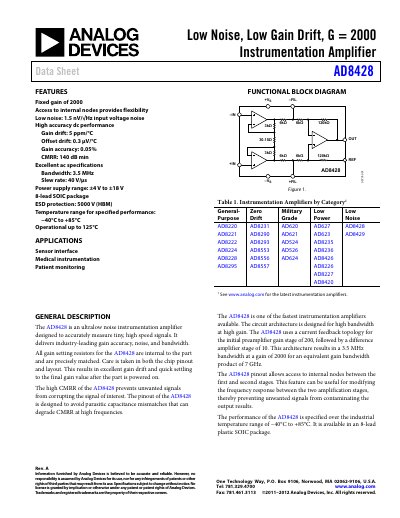
The AD8428 is an ultralow noise instrumentation amplifier designed to accurately measure tiny, high speed signals. It delivers industry-leading gain accuracy, noise, and bandwidth. All gain setting resistors for the AD8428 are internal to the part and are precisely matched. The high CMRR of the AD8428 prevents unwanted signals from corrupting the signal of interest.
The device uses a current feedback topology for the initial preamplifier gain stage of 200, followed by a difference amplifier stage of 10. This architecture results in a 3.5 MHz bandwidth at a gain of 2000 for an equivalent gain bandwidth product of 7 GHz. The AD8428 is specified over the industrial temperature range of −40°C to +85°C and is available in an 8-lead plastic SOIC package.
| Fixed Gain | 2000 |
|---|---|
| Input Voltage Noise | 1.5 nV/√Hz |
| Gain Drift | 5 ppm/°C |
| Offset Drift | 0.3 μV/°C |
| CMRR | 140 dB min |
| Bandwidth | 3.5 MHz |
| Slew Rate | 40 V/μs |
| Power Supply Range | ±4 V to ±18 V |
| Package | 8-lead SOIC |
| Temperature Range | −40°C to +85°C |
The AD8428 has a fixed gain of 2000.
The bandwidth is 3.5 MHz at a gain of 2000.
The minimum CMRR is 140 dB.
The input voltage noise is 1.5 nV/√Hz.