
Applying Instrumentation Amplifiers Effectively: The Importance of an Input Ground Return

This document discusses some challenges and solutions in the design of instrumentation amplifiers, including capacitor and resistor selection, input bias current matching, DC accuracy, signal-to-noise ratio, etc.
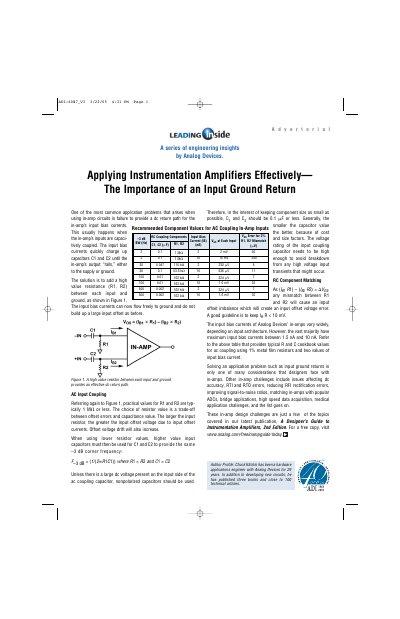

Applying Instrumentation Amplifiers Effectively: The Importance of an Input Ground Return - cover page
Brand
Leading
Category
Other Electronics
Document type
Application Note
Language
English
Pages
1
File format
PDF
File size
121 KB
Published
03 August, 2012
Updated
29 September, 2023
MD5 checksum
86EDC5DAFAFE5451DFB8E1117C24F649

About this manual

This document addresses a common problem with instrumentation amplifier (in-amp) circuits where failure to provide a DC return path for input bias currents causes the output to saturate at the supply rails. This issue typically arises when inputs are capacitively coupled, causing bias currents to charge coupling capacitors until saturation occurs.

What's inside

  • Input Ground Return
  • AC Coupling In-Amp Inputs
  • Recommended Component Values
  • RC Component Matching
  • Input Bias Currents

Frequently asked questions

What is the recommended maximum value for AC coupling capacitors C1 and C2?

The values should be 0.1 uF or less to keep component size small.

What are the typical maximum input bias currents for Analog Devices in-amps?

They vary widely but most have maximum values between 1.5 nA and 10 nA.

Download PDF (121 KB)

More Leading Manuals


View all Leading manuals →