
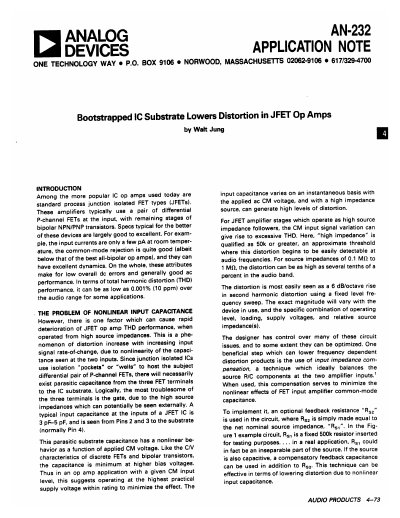
Analog Devices AN-232 Application Note Bootstrapped IC Substrate Lowers Distortion in JFET Op Amps


Analog Devices AN-232 Application Note Bootstrapped IC Substrate Lowers Distortion in JFET Op Amps - cover page
Brand
Analog Devices
Category
Other Electronics
Document type
Application Note
Language
English
Pages
4
File format
PDF
File size
206 KB
Published
02 August, 2012
Updated
20 August, 2012
MD5 checksum
67E8D8F08207EEAB8ACD66EC7590BB7D

About this manual

This document describes a technique to lower total harmonic distortion (THD) in Junction Field-Effect Transistor (JFET) operational amplifiers when operated from high source impedances. The distortion arises from the nonlinear behavior of the parasitic capacitance between the FET terminals and the IC substrate. The note details a circuit method using a buffer amplifier and a feedback divider to drive the substrate with a signal equal to the input, effectively minimizing the voltage across the input capacitance.

What's inside

  • Introduction
  • The Problem of Nonlinear Input Capacitance
  • Minimizing Nonlinear Input Capacitance Effects
  • Design Factors
  • Performance
  • Unbuffered Bootstrap
  • Application Tips

Frequently asked questions

What causes rapid deterioration of JFET op amp THD performance at high source impedances?

This is caused by a phenomenon of distortion increase with increasing input signal rate-of-change, due to nonlinearity of the capacitance seen at the two inputs.

What is the approximate threshold for high source impedance where distortion becomes detectable?

Distortion begins to be easily detectable at audio frequencies when the source impedance is 50k or greater.

How does the bootstrap technique reduce distortion?

It reduces distortion by driving the U1 substrate with a signal equal to that at the (+) input, which reduces the voltage across the input capacitance.

Download PDF (206 KB)

More Analog Devices Manuals


View all Analog Devices manuals →