
This application note introduces the design guidelines for the FAN6754A PWM controller, which features green mode, frequency hopping, constant power limit, and various protection functions. The power supply can meet stringent standby power regulations by maximizing light-load efficiency, and frequency hopping reduces electromagnetic emission. The constant-power-limit function minimizes component stress in abnormal conditions, and integrated protection functions improve reliability without increasing system cost. This application note explains how to replace the SG6742 PWM controller with the FAN6754A and provides a summary of the differences between the two devices.
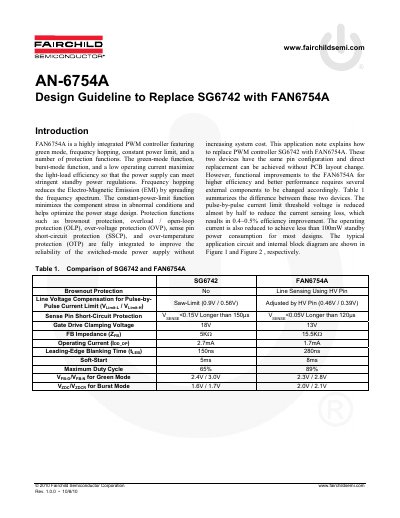
The FAN6754A is a highly integrated PWM controller featuring green mode, frequency hopping, constant power limit, and various protection functions. It offers a direct replacement for the SG6742 with the same pin configuration, allowing for PCB layout changes without modification. Functional improvements include reduced operating current for lower standby power and enhanced efficiency through reduced current sensing loss.
The document provides detailed guidance on circuit modifications required for the transition. Key changes involve adjusting the feedback resistor to account for the higher FB impedance, modifying the HV startup circuit for better line surge immunity, and utilizing the two-step UVLO mechanism. It also covers the operation of the internal soft-start, green-mode, and burst-mode functions, along with specific considerations for the output driver and current sensing.
| Operating Current | 1.7mA |
|---|---|
| Maximum Duty Cycle | 89% |
| Soft-Start Time | 8ms |
| FB Impedance | 15.5KQ |
| Gate Drive Clamping Voltage | 13V |
Yes, the two devices have the same pin configuration and direct replacement can be achieved without PCB layout change.
The operating current is reduced to achieve less than 100mW standby power consumption for most designs.
The feedback resistor should be three times the original value because the FAN6754A has a larger internal pull-up resistor.