
The PNOZ XV2.1 is a safety relay produced by Pilz that monitors NOT-AUS buttons and protection doors. It has two safety contacts (S), one undelayed and one delayed. It can be connected to NOT-AUS buttons, protection door limit switches and start buttons. It also has an LED display for showing the channel 1/2 switch status, power supply voltage and start circuit. The delay time can be canceled by the reset button.
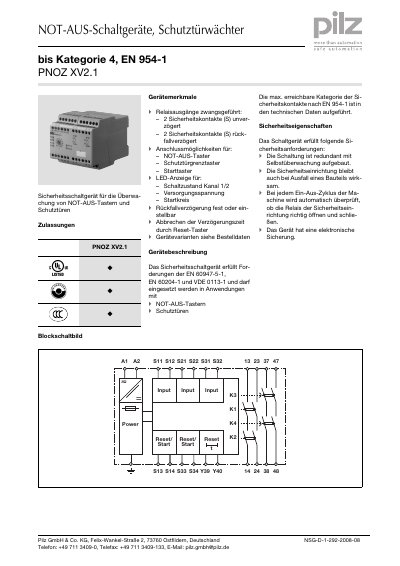
The document provides technical specifications for the Pilz PNOZ XV2.1 safety switchgear device. It details the device's capabilities in monitoring emergency stop buttons and protective door switches up to Category 4 according to EN 954-1.
Key features include redundant circuit construction with self-monitoring, forced-guided relay outputs (both immediate and delayed), and support for one or two-channel operation with cross-circuit detection. The datasheet lists electrical data such as supply voltage ranges, power consumption, contact ratings, and timing parameters for start-up and reset delays. This manual is written in German.
| Supply Voltage Range | AC/DC 24 - 240V |
|---|---|
| Power Consumption (AC) | 8.5 VA |
| Power Consumption (DC) | 50W |
| Frequency Range (AC) | 50 - 60 Hz |
| Input Voltage (DC) | 24.0 V |
| Max Total Line Resistance (Single Channel, DC) | 200 Ohm |
| Contact Material | AgSnO2 + 0.2 Hm Au |
The device supports up to Category 4 according to EN 954-1.
Yes, the circuit is built redundantly with self-monitoring.