
This document describes the features and characteristics of SUPERFLEX PU PLUS H, which is mainly used for suction and ducting of dust, saw-dust and other abrasive material, granules and dusts of chemical products, etc. It has high mechanical protection, is highly flexible, and has a smooth inside surface. It is resistant to abrasion, traction, oils and fuels, diluted alkaline solutions and acids, U.V. rays, and atmospheric agents. The working temperature range is -40°C to +90°C, with a short period of up to 125°C.
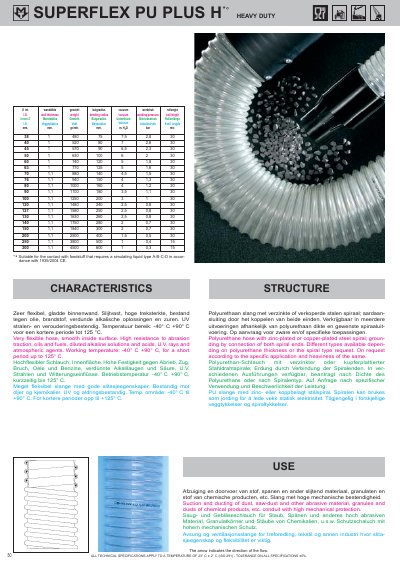
This document provides technical specifications for the MERLETT SUPERFLEX PU PLUS H heavy duty polyurethane hose. It includes a table of data relating wall thickness, weight, bending radius, vacuum, working pressure, and coil length to various hose diameters ranging from 38mm to 300mm. The document notes that all specifications apply to a temperature of 23°C ± 2°C with a tolerance of ±5% on all specifications.
The hose is described as very flexible with a smooth inside surface. It offers high resistance to abrasion, traction, oils, fuels, diluted alkaline solutions, acids, UV rays, and atmospheric agents. The working temperature range is -40°C to +90°C, with a short-term limit up to 125°C. The hose structure consists of polyurethane with a zinc-plated or copper-plated steel spiral, and grounding is achieved by connecting both spiral ends. It is suitable for suction and ducting of dust, saw-dust, other abrasive material, granules, and dusts of chemical products.
| Short-term temperature limit | 125° C |
|---|---|
| Resistance to | oils and fuels, diluted alkaline solutions and acids |
| Resistance to environmental factors | UV rays and atmospheric agents |
| Structure material | Polyurethane with steel spiral |
| Grounding method | Connection of both spiral ends |
| Standard test temperature | 23° C + 2° C |
Yes, it is suitable for contact with foodstuff requiring a simulating liquid type A-B-C-D in accordance with 1935/2004 CE.
The tolerance on all specifications is ±5%.
Grounding is achieved by connecting both spiral ends.