
Agilent 1100 Series Well Plate Autosampler is suitable for high-throughput analysis and various other needs. It provides the best solution for all applications. The features include high-speed sample injection, overlap injection function, automatic delay volume suppression, various plate types, cooling function, and user-friendly safety design.
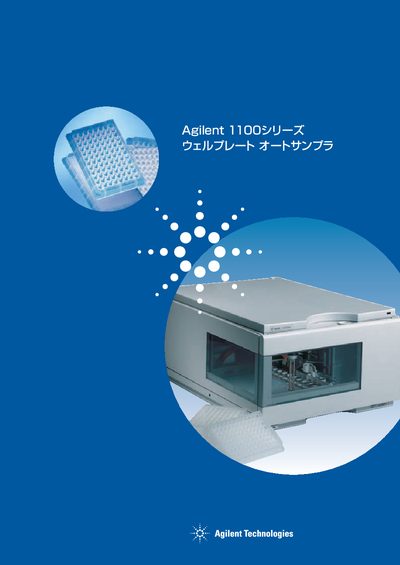
The Agilent 1100 Series Well Plate Autosampler is designed for high-throughput analysis, offering injection speeds approximately twice that of standard autosamplers. It supports various sample formats, including 96-well and 384-well plates (up to 768 samples) and 2ml vials, with an optional cooling function for thermally unstable samples.
Key features include an overlap injection function to prepare the next sample during the current analysis cycle, automatic suppression of delay volume to minimize gradient delay, and a built-in needle wash port to ensure accurate injection and prevent carryover (0.007%). The system also features a safety design that locks the door during needle movement and stops the system upon error detection. This manual is written in Japanese.
| Injection Speed | Approximately 2x standard autosampler |
|---|---|
| Max Samples | 768 (384-well plate x 2) |
The system supports up to 768 samples using two 384-well plates.
Yes, an optional cooling function is available to analyze thermally unstable samples.