
This document introduces the stray-light test of Agilent 8453 UV-visible spectrophotometer, including the test principle, test method, test steps, test results and test conclusions.
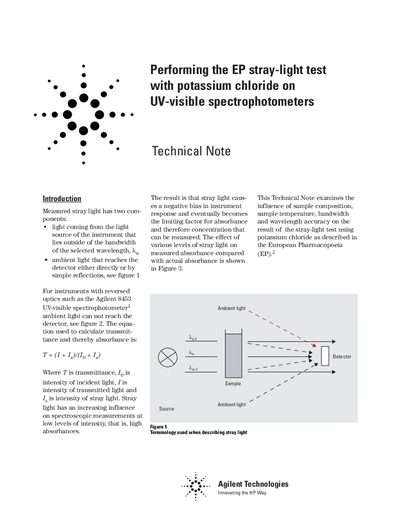
This document is a technical note that examines the influence of various factors on the results of the European Pharmacopoeia (EP) stray-light test when using potassium chloride as a filter. It specifically addresses the Agilent 8453 UV-visible spectrophotometer and discusses how sample composition, temperature, bandwidth, and wavelength accuracy affect the measurement.
The text details the requirements for the potassium chloride solution, noting that the EP allows a maximum of 0.1% bromide content. It explains that higher bromide concentrations shift the absorption edge, leading to test failure, while ultra-pure samples may yield transmittance values exceeding the EP limit. The document also provides recommendations for integration time and temperature control during the test.
| Recommended temperature for test | 20°C +1°C |
|---|---|
| Integration time used for tests | 5s |
| Maximum allowed bromide content | 0.1% |
| Wavelength at 50% transmittance limit | < 211 nm |
The absorbance of a 12 g/l solution of potassium chloride in a 1 cm cell should be greater than two at 200 nm when compared with water.
It is the most critical because the measured wavelength is situated very close to the cut-off slope, making the test extremely sensitive to wavelength accuracy.
Increased bromide concentrations lead to lower percentage transmittance values at 200 nm and shift the wavelength at 50% transmittance, potentially causing test failure.