
This paper introduces a flow modulated comprehensive two-dimensional gas chromatography method with parallel flame ionization detector/mass spectrometry for the analysis of bacterial fatty acids.
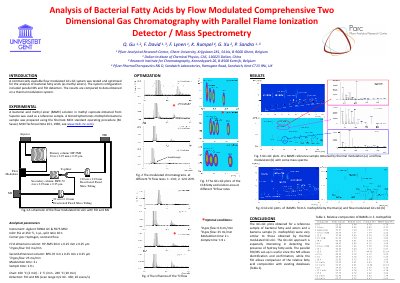
The document describes the testing and optimization of a commercially available flow modulated GCxGC system for analyzing bacterial fatty acid methyl esters (BAMEs). The system configuration included parallel mass spectrometry (MS) and flame ionization detection (FID). Results obtained from this flow modulation system were compared against data from a thermal modulation system using a reference sample and a Stenotrophomonas maltophilia bacteria sample.
The study details the experimental setup, including specific instrument parameters such as column dimensions, gas flows, and oven temperatures. It presents chromatographic results, including GCxGC plots and mass spectra, demonstrating the system's ability to detect hydroxy fatty acids and compare relative fatty acid compositions with existing databases.
| Primary column | HP-5MS 30 m x 0.25 mm x 0.25 um |
|---|---|
| Instrument | Agilent 7890A GC & 5975 MSD |
| Inlet temperature | 250 °C |
| Carrier gas | Hydrogen, constant flow |
| Modulation time | 2 s |
| Sample time | 1.9 s |
| Oven temperature range | 100 °C to 240 °C |
| MS scan range | m/z 40 - 430 |
A Stenotrophomonas maltophilia bacteria sample was prepared using the Sherlock MIDI standard operating procedure.
The optimal conditions for the first dimension gas flow are 0.6 mL/min.
The optimal conditions for the second dimension gas flow are 25 mL/min.