
The document describes the design focus of the Agilent Cary 600 FTIR Series spectrometers on performance optimization, achieved through innovative optics design with an emphasis on optical throughput. The result is unrivaled sensitivity and performance. Although a larger footprint is required, this is a negligible compromise for the customer, given the ability to quickly produce results of the highest available accuracy and precision, resulting in increased productivity and profitability.
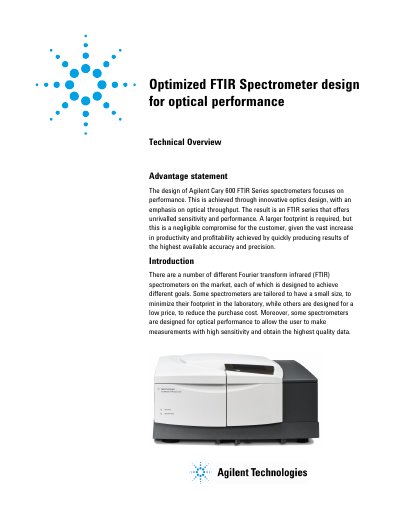
This document provides a technical overview of the design philosophy behind the Agilent Cary 600 FTIR Series spectrometers. It explains how innovative optics design prioritizes optical throughput to achieve unrivalled sensitivity and performance, even if it results in a larger footprint compared to other models.
The text details specific design choices made for the infrared source and interferometer. Key features include an optimized air-cooled source with a retro-reflector that doubles image size, high-efficiency f/0.7 optics, and a dynamically-aligned Michelson interferometer with a 30-degree incident angle to maximize projected beamsplitter area.
The f-number of the source optics in Agilent FTIR spectrometers is 0.7.
The Agilent air bearing spectrometers (Cary 670/680 FTIR) typically deliver more than 160 mW of infrared power at the sample.