
The content of this document is about the query of TEA1067N suppliers. This product is copyrighted by its respective manufacturer. Further inquiry is needed about the features and characteristics of this product.
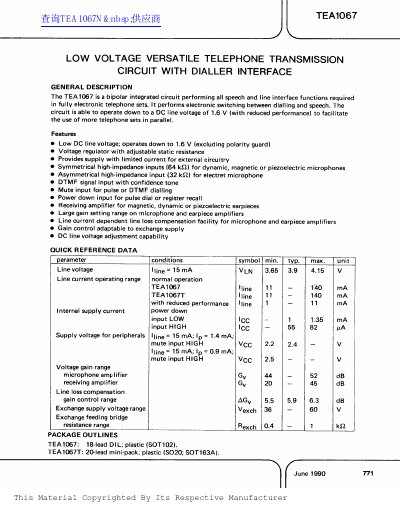
The TEA1067 is a bipolar integrated circuit designed to perform all speech and line interface functions required in fully electronic telephone sets. It handles electronic switching between dialling and speech, supporting both pulse and DTMF dialling. The circuit is notable for its ability to operate with a low DC line voltage of 1.6V, facilitating the use of more telephone sets in parallel.
The device includes features such as a voltage regulator with adjustable static resistance, symmetrical high-impedance inputs for various microphone types, and a receiving amplifier for magnetic, dynamic, or piezoelectric earpieces. It also provides gain control adaptable to the exchange supply and includes facilities for line loss compensation.
| Microphone Amplifier Gain Range | 44 - 52 dB |
|---|---|
| Receiving Amplifier Gain Range | 20 - 45 dB |
| Exchange Supply Voltage Range | 36 - 60 V |
| Package Type | 18-lead DIL or 20-lead mini-pack |
The circuit is able to operate down to a DC line voltage of 1.6 V (with reduced performance).
The device supports dynamic, magnetic, piezoelectric, and electret microphones.
When MUTE is HIGH, the DTMF input is enabled and the microphone and receiving amplifier inputs are inhibited.