
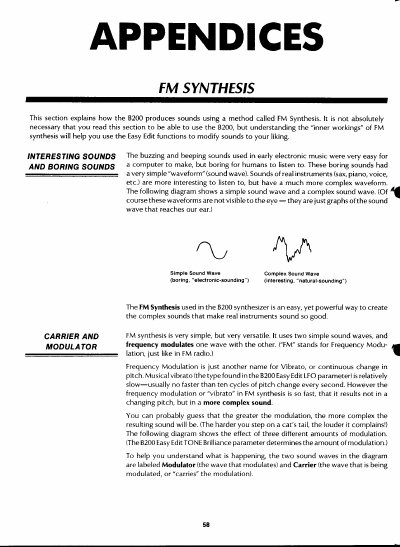
This document provides technical appendices regarding the FM Synthesis method used in the Yamaha B200. It explains how frequency modulation creates complex sound waves by modulating a carrier with a modulator, detailing the roles of output levels and frequencies in shaping tone and volume.
The text further describes the internal architecture involving four operators connected via eight different algorithms, including self-modulation known as feedback. Additionally, it covers MIDI applications, illustrating how the B200 can control other instruments like the TX81Z and RX120 for multi-timbral performance and synchronized rhythm programming.
The modulator output level determines the tone, while the carrier output level determines the volume.
The B200 has four operators that can be connected in eight different ways.
Feedback occurs when a single operator modulates itself, producing a more complex and brighter sound.