
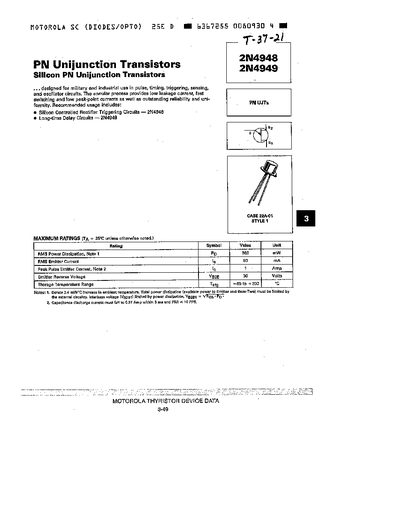
This document is a datasheet for Motorola's 2N4948 and 2N4949 Silicon PN Unijunction Transistors. These devices are designed for military and industrial use in pulse, timing, triggering, sensing, and oscillator circuits. The manufacturing process ensures low leakage current, fast switching, and low peak-point currents.
| RMS Power Dissipation | 360 mW |
|---|---|
| RMS Emitter Current | 60 mA |
| Peak Pulse Emitter Current | 1 Amp |
| Emitter Reverse Voltage | 30 Volts |
| Storage Temperature Range | -85 to +200 C |
| Intrinsic Standoff Ratio (2N4948) | 0.65 to 0.82 |
| Intrinsic Standoff Ratio (2N4949) | 0.74 to 0.86 |
| Interbase Resistance | 4 to 12 k ohms |
| Maximum Oscillation Frequency | 400 kHz |
Recommended usage includes Silicon Controlled Rectifier Triggering Circuits for the 2N4948 and Long-time Delay Circuits for the 2N4949.
The intrinsic standoff ratio for the 2N4948 is between 0.65 and 0.82 when Vag1 is 10 V.
The maximum oscillation frequency (fimaxd) is approximately 400 kHz.