
This article introduces how to choose a suitable voltage reference, which introduces the purpose, characteristics and specifications of voltage reference
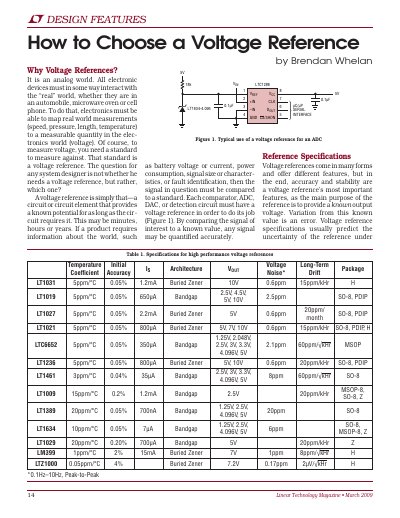
This document discusses the critical role of voltage references in electronic systems such as comparators, ADCs, and DACs. It explains that a voltage reference provides a known potential against which signals can be accurately measured or compared.
The guide details key specifications for evaluating voltage references, including initial accuracy, temperature drift (TC), long-term stability, and thermal hysteresis. It also describes the two main types of voltage references offered by Linear Technology: shunt and series architectures.
Accuracy and stability are the most important features, as the main purpose is to provide a known output voltage.
Temperature drift is caused by imperfections and nonlinearities in the circuit elements.
The two main types of voltage reference are shunt and series.