
This document introduces Linear Technology's TimerBlox family of products, which are silicon timing devices that solve specific timing problems. TimerBlox devices can easily be integrated into designs with minimal effort and space requirements. They offer higher efficiency and accuracy compared to microcontroller or discrete-component solutions.
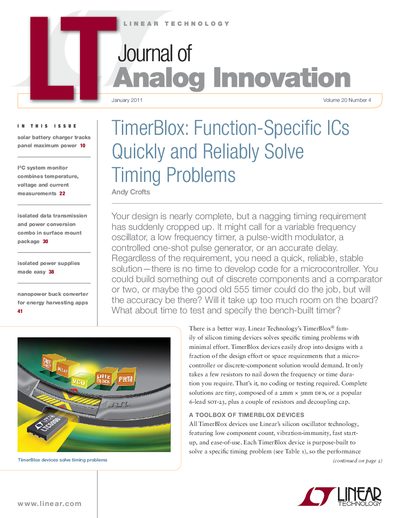
This document introduces the Linear Technology TimerBlox family, a series of function-specific integrated circuits (ICs) intended to replace complex microcontroller code or discrete component solutions for timing applications. The devices are highlighted for their low component count, vibration immunity, fast startup times, and ease of use, requiring only a few resistors to configure frequency or time duration.
| Supply Voltage Range | 2.25V to 5.5V |
|---|---|
| Operating Temperature Range | -40°C to 125°C |
| LTC6990 Output Frequency Range | 8Hz to 2MHz |
| LTC6991 Period Range | 1ms to 9.5 hours |
| LTC6992 PWM Frequency Range | 3.8Hz to 1MHz |
| LTC6993 One-Shot Duration | 1us to 34 sec |
| LTC6994 Delay Range | 1us to 34 sec |
They solve specific timing problems with minimal effort, requiring only a few resistors and no coding or testing.
It only takes a few resistors to nail down the frequency or time duration you require.
The LTC6990 maintains a large 4096:1 total frequency range.