
This document introduces the features and characteristics of EVB7122 27 to 930MHz transceiver evaluation board, including single-chip solution, stand-alone fixed-frequency user mode, programmable multi-channel user mode, low current consumption, PLL-stabilized RF VCO (LO), lock detect output, On-chip AFC, FSK/ASK mode selection, RSSI output, ASK detection, switchable LNA gain, automatic PA turn-on, ASK modulation, 3wire bus serial control interface, EVB comes with a cable to connect to a PC's LPT port, EVB programming software is available on Melexis web site.
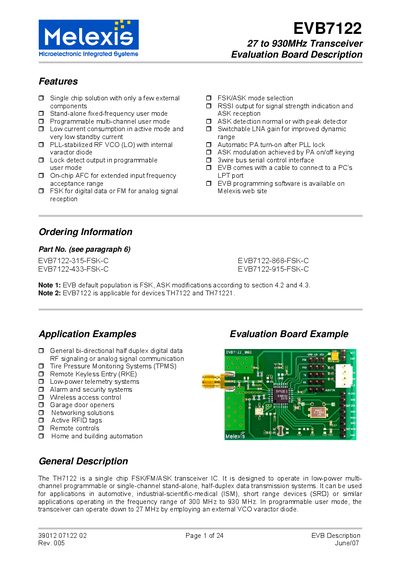
The EVB7122 evaluation board provides a single‑chip solution for the Melexis TH7122 transceiver, covering frequencies from 27 MHz up to 930 MHz. It supports both stand‑alone fixed‑frequency operation and a programmable user mode via a 3‑wire serial control interface.
The document details hardware features, application examples (e.g., TPMS, remote keyless entry, RFID), technical specifications, register settings, package dimensions, and soldering guidelines, along with legal disclaimer information.
| Frequency range | 300 MHz – 930 MHz |
|---|---|
| Power supply range | 2.2 V – 5.5 V |
| Standby current | 50 nA |
| Operating current (receive) | 6.5 mA (low gain) |
| Operating current (transmit) | 12 mA (at -2 dBm) |
| Temperature range | -40 °C to +85 °C |
Programming is done via a 3‑wire Serial Control Interface (SCI) using the SCLK, SDTA, and SDEN pins.
The device supports ASK and FSK modulation; ASK is achieved by PA on/off keying and FSK by frequency shift.