
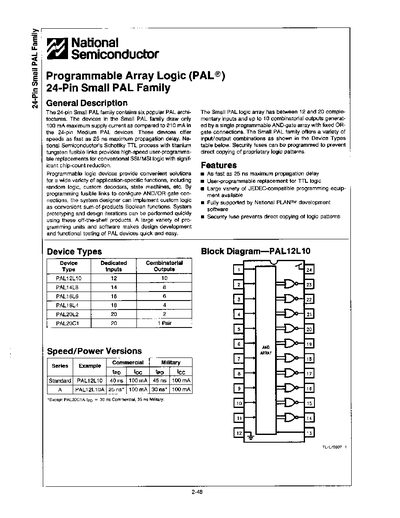
The 24‑Pin Small PAL family from National Semiconductor provides six PAL architectures with low power consumption (100 mA max) and fast propagation delays as low as 25 ns. These devices replace conventional SSI/MSI TTL logic, offering up to 20 inputs and 10 combinatorial outputs in a 24‑pin DIP package.
The datasheet includes absolute maximum ratings, recommended operating conditions, electrical and switching characteristics, pin‑out diagrams, and information on security fuses that prevent copying of programmed logic. Design support tools such as the PLANT software and JEDEC‑compatible programming equipment are also described.
| Maximum supply current | 100 mA |
|---|---|
| Maximum propagation delay | 25 ns |
| Supply voltage range | 0.5 V to 7.0 V |
| Input voltage range | -1.5 V to +5.5 V |
| Operating temperature range (free‑air) | -55 °C to +75 °C |
| Junction temperature range | -65 °C to +150 °C |
| Number of inputs | 12–20 |
| Maximum combinatorial outputs | 10 |
The devices draw a maximum supply current of 100 mA.
The fastest propagation delay offered is 25 ns.
It provides between 12 and 20 complementary inputs and up to 10 combinatorial outputs.
Free‑air temperature is –55 °C to +75 °C, and junction temperature is –65 °C to +150 °C.