
SA2030 is a PCM frame aligner produced by Siemens. It can be used for interfacing between PCM systems operating with different clocks and PCM concentrators and subscriber multiplexers. The device can be used for delay compensation and clock alignment between 2,048MHz PCM- 30 transmission lines and terminating equipment, as well as jitter and drift control within digital networks.
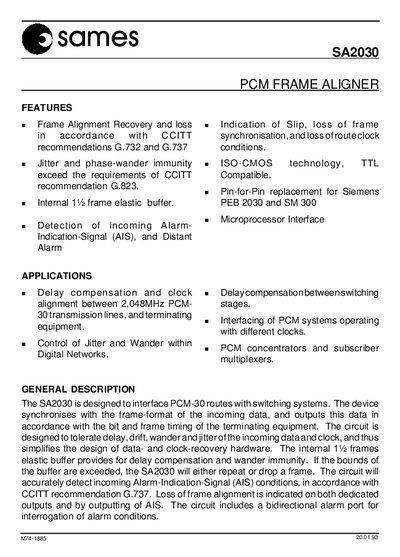
The SA2030 PCM Frame Aligner is designed to interface PCM‑30 routes with switching systems, synchronising frame format and providing delay compensation, jitter and wander immunity. It detects Alarm‑Indication‑Signal (AIS) and indicates loss of frame alignment on dedicated outputs.
The manual covers pin configuration, functional operation of the PCM input and output, elastic buffer behavior, alarm subsystem commands, and detailed electrical characteristics such as supply voltage, clock frequencies, and power consumption.
| Supply voltage (Vop) typical | 4.75‑5.25 V |
|---|---|
| Route Clock Input (RCL) frequency | 2.048 MHz |
| System Clock Input (SCL) frequency | 2.048 MHz |
| Elastic buffer capacity | 1 % frame (112‑frame buffer) |
| Operating power consumption | 25 mW |
| Input high voltage (Vi) | 2.4 V |
| Input low voltage (Vi) | 0.8 V |
| Output high voltage (Vout) | 2.7 V |
| Output low voltage (Vlow) | 0.4 V |
| High‑impedance leakage current | 50 nA |
The SA2030 is designed to interface PCM‑30 routes with switching systems, synchronising frame format and providing delay compensation, jitter and wander immunity.
Loss of frame alignment is indicated on dedicated outputs and by outputting an Alarm‑Indication‑Signal (AIS).
Pins DB1 and DB2 are bidirectional alarm ports used for alarm communication.
Setting the Bl pin true inhibits the 1 % frame buffer, limiting the output timing to within one frame.