
The document describes the features and characteristics of XL Photonics, Inc.'s XPD0250CT-001 2.5 Gbps PIN-TIA module, including wide dynamic range, differential transimpedance, bandwidth, differential outputs, automatic gain control, etc.
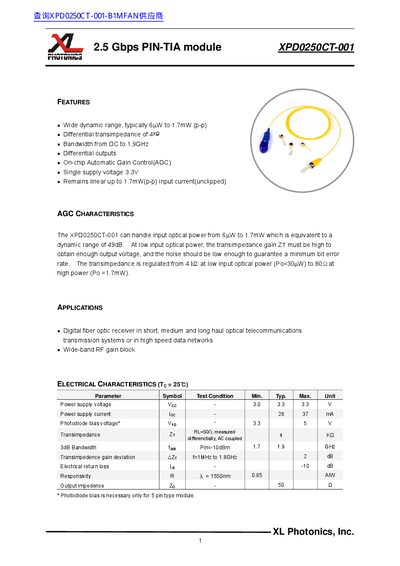
The XPD0250CT-001 is a 2.5 Gbps PIN‑TIA receiver module designed for digital fiber‑optic receivers and wide‑band RF gain applications. It features a differential transimpedance of about 4.2 kΩ, automatic gain control, and operates from a single 3.3 V supply while remaining linear up to 1.7 mW input power.
Typical applications include short, medium and long‑haul optical telecommunications, high‑speed data networks, and broadband RF gain blocks. The module is available in 4‑pin and 5‑pin configurations, with optional fiber‑optic connectors and mechanical options listed in the ordering information.
| Data rate | 2.5 Gbps |
|---|---|
| Supply voltage | 3.3 V |
| Supply current | 37 mA (typical) |
| Photodiode bias voltage | 3.3 V (typical) |
| Transimpedance gain | ≈4.2 kΩ (low power) |
| Responsivity at 1550 nm | 0.85 A/W |
| Optical wavelength range | 1100–1600 nm |
| Operating temperature range | -20 °C to +75 °C |
It handles input optical power from 6 µW to 1.7 mW, giving a dynamic range of about 49 dB.
The module operates from a single 3.3 V supply.
Standard 4‑pin and 5‑pin layouts are offered, and other configurations can be ordered as custom.
Use ground straps, anti‑static mats, and other standard ESD protection equipment.