
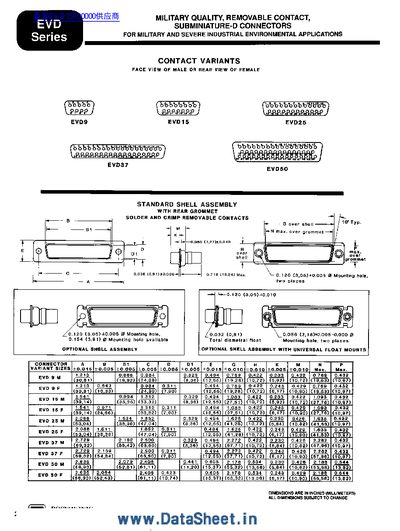
The EVD Series subminiature‑D connectors are designed for military and severe industrial environments. They feature removable contacts, optional shell assemblies, and a range of mounting and locking options. Materials include glass‑filled DAP insulators, precision‑machined brass contacts, and steel or brass shells with zinc‑plate and dichromate sealing.
Technical characteristics cover electrical ratings (7.5 A contact current, 0.005 Ω max contact resistance, 1000 V rms working voltage), mechanical durability (9 lb contact retention, 500 mating cycles), and environmental performance (55 °C to +125 °C temperature range, MIL‑STD 810 humidity and immersion tests). Ordering information and code numbering are provided for custom configurations.
| Contact Current | 7.5 A (nominal) |
|---|---|
| Initial Contact Resistance | 0.005 Ω max |
| Working Voltage | 300 V rms |
| Contact Retention | 9 lb (40 N) |
| Plating Thickness | 1.25 µm gold over copper |
| Temperature Range | ‑55 °C to +125 °C |
| Mating Cycles | ≥500 cycles |
The connectors are rated for a nominal contact current of 7.5 amperes.
The initial contact resistance must not exceed 0.005 ohms.
They are specified for operation from –55 °C up to +125 °C.
They meet MIL‑C‑24308, MIL‑C‑39029, MIL‑STD 1344 and MIL‑STD 810 requirements.