
The LTC®3808 is a synchronous step-down switching regulator controller that drives external complementary power MOSFETs using few external components. The constant frequency current mode architecture with MOSFET VDS sensing eliminates the need for a current sense resistor and improves efficiency. By employing Spread Spectrum modulation technology, the device achieves low noise over a wide input voltage range.
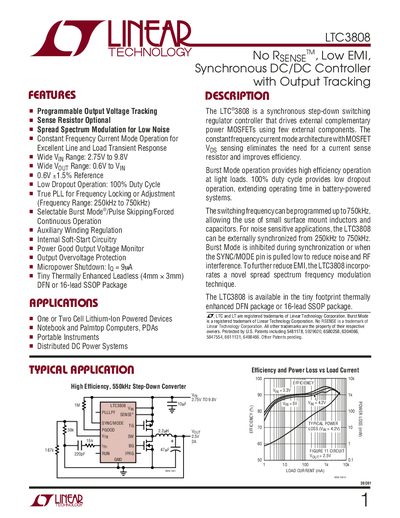
This handbook describes the LTC3808 synchronous step‑down switching regulator controller. It outlines key features such as programmable output voltage tracking, spread‑spectrum modulation, and internal soft‑start circuitry. The document includes typical applications, absolute maximum ratings, and detailed electrical characteristics.
The data sheet also lists pin functions, package options (DFN and 16‑lead SSOP), and performance graphs for efficiency, current sense voltage, and switching frequency. Related parts and ordering information are provided at the end of the document.
| Operating Temperature Range | -40 °C to 85 °C |
|---|---|
| Switching Frequency Range | 250 kHz to 750 kHz |
| Package Options | 4 mm DFN or 16‑lead SSOP |
The LTC3808 can be programmed to operate between 250 kHz and 750 kHz.
The LTC3808 is offered in a 4 mm DFN package and a 16‑lead SSOP package.