
Specifications of Crystek CYxx crystal quartz resonators, including frequency range, temperature range, load capacitance, drive level, ESR, etc.
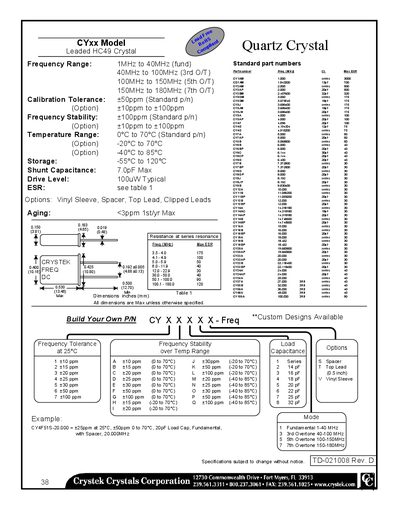
The CYxx series of leaded HC49 quartz crystals from Crystek covers a wide frequency range from 1 MHz up to 180 MHz across fundamental and overtone modes. Standard parts offer a calibration tolerance of ±50 ppm and frequency stability of ±100 ppm, with optional tighter tolerances available.
Electrical characteristics include a typical drive level of 100 µW, a maximum shunt capacitance of 7.0 pF, and various load options such as vinyl sleeves, spacers, and top‑lead configurations. The crystals operate over a standard temperature range of 0 °C to 70 °C and can be stored between 55 °C and 120 °C.
| Calibration Tolerance | +50 ppm (Standard part number) |
|---|---|
| Frequency Stability | +100 ppm (Standard part number) |
| Temperature Range | 0 °C to 70 °C (Standard part number) |
| Storage Temperature | 55 °C to 120 °C |
| Shunt Capacitance | 7.0 pF max |
| Drive Level | 100 µW typical |
| Aging | <3 ppm per year max |
| Options | Vinyl Sleeve, Spacer, Top Lead, Clipped Leads |
The standard calibration tolerance is ±50 ppm.
Standard CYxx crystals operate from 0 °C to 70 °C.
The typical drive level is 100 µW.
They should be stored between 55 °C and 120 °C.