
Introduces the basic principle and classification of universal joints, and introduces the characteristics of universal joints in this catalog
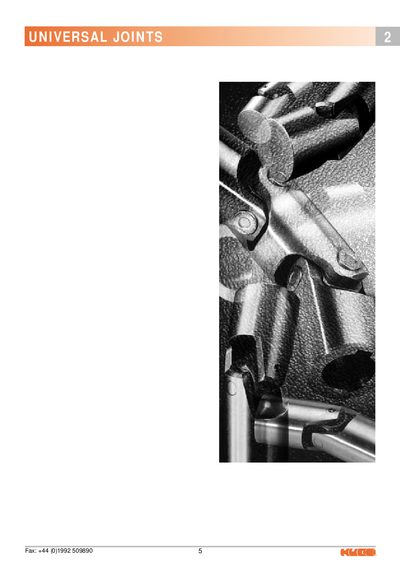
The Huco catalogue explains the basic principles of universal (U/J) joints, describing how they transmit rotation between misaligned shafts and the difference between constant‑velocity and non‑constant‑velocity designs. It covers applications such as drive shafts, power take‑offs and machine tools, and explains the benefits of using pairs of joints for constant‑velocity output.
The document lists the available joint types (plain bearing, needle‑roller, stainless steel, ball joint, quick‑release), their size ranges, maximum operating speeds and angles, torque capacities, and recommended lubrication. Ordering codes, bore dimensions and optional telescopic drive shafts are provided for custom configurations.
| Maximum speed (plain bearing TL/TS joints) | 1200 rpm |
|---|---|
| Maximum speed (needle roller TR joints) | 6000 rpm |
| Maximum working angle (single joint) | 40° |
| Maximum working angle (double joint) | 80° |
| Torque capacity (TL joint, size 13) | 19 Nm |
Plain bearing universal joints (TL/TS) are rated for up to 1200 rpm.
By using a double joint or two single joints back‑to‑back, with equal operating angles and aligned inboard lugs, the speed fluctuations cancel out.
Single joints are limited to 40°, while double joints can operate up to 80° (for sizes 13‑45).