
The document describes the features and characteristics of an infrared thermometer, including dual laser pointers, wide temperature range, adjustable emissivity, and fast response time.
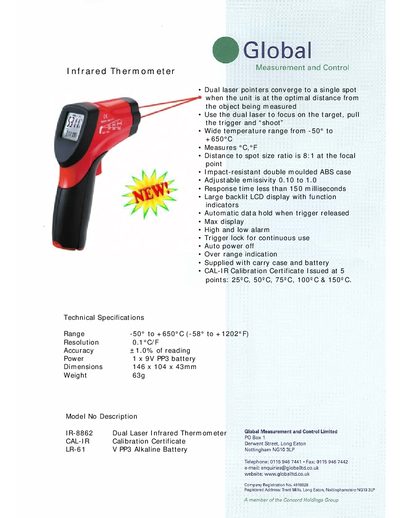
The IR-8862 is a dual‑laser infrared thermometer designed for fast, non‑contact temperature measurement. Dual laser pointers converge to a single spot, allowing precise targeting, while a large backlit LCD displays temperature readings and function indicators. The device includes adjustable emissivity, high/low alarms, trigger lock, and automatic power‑off.
Technical specifications include a temperature range of -50°C to +650°C, 0.1°C resolution, ±1.0% accuracy, 8:1 distance‑to‑spot ratio, and a response time under 150 ms. It is powered by a single 9 V PP3 alkaline battery, measures 146 × 104 × 43 mm, and weighs 63 g. The thermometer ships with a carry case, battery, and a CAL‑IR calibration certificate.
| Temperature range | -50°C to +650°C |
|---|---|
| Resolution | 0.1°C / 0.1°F |
| Accuracy | ±1.0% of reading |
| Power source | 1 × 9V PP3 alkaline battery |
| Dimensions | 146 × 104 × 43 mm |
| Weight | 63 g |
| Emissivity range | 0.10 to 1.0 |
| Response time | <150 ms |
| Distance‑to‑spot ratio | 8:1 at focal point |
| Display | Large backlit LCD with function indicators |
It measures temperatures from -50 °C to +650 °C.
The device is powered by a single 9 V PP3 alkaline battery.
Its response time is less than 150 milliseconds.