
This manual introduces how to quickly use the LPC2103 USB QuickStart Board to enable users to start developing on Day 1.
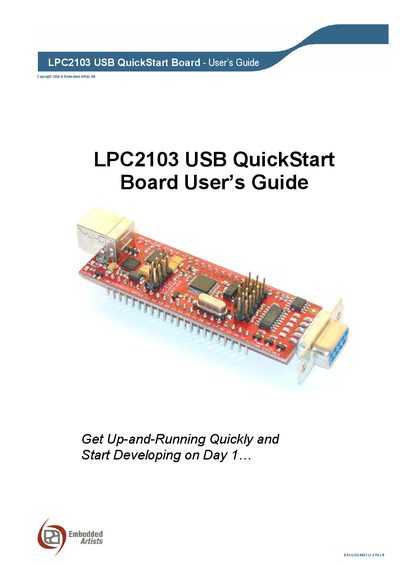
This guide introduces the LPC2103 USB QuickStart Board, a low‑cost development platform based on the Philips ARM7TDMI LPC2103 microcontroller. It describes the board’s contents, required power supplies, and optional accessories such as a serial extension cable, USB cable, prototype board, and JTAG interface.
Detailed sections cover the board schematics, jumper settings, ISP programming via USB, and how to obtain additional software and documentation from the included CD‑ROM. Registration information and links to further reference manuals are also provided.
| Microcontroller Flash | 32 KByte |
|---|---|
| Microcontroller SRAM | 8 KByte |
| Main crystal frequency | 14.745600 MHz |
| RTC crystal frequency | 32.768 kHz |
| USB‑to‑UART bridge | CP2102 (Silabs) |
| Voltage regulator outputs | +3.3 V and +1.8 V |
| Power supply requirement | 5‑10 VDC, ≥150 mA |
| Board dimensions | 26 mm × 77 mm |
| I/O connectors | Dual 22‑pin connectors |
The board requires a 5‑10 VDC supply capable of at least 150 mA, or it can be powered directly from the USB connector.
The CP2102 USB‑to‑UART bridge allows ISP program download over USB when UART#0 is selected.
Set jumpers J12, J11, J9 and J10 to the upper position; this connects USB to UART#0 on the LPC2103.