
LPC2106 QuickStart Board User's Guide, introduces the features and characteristics of the board and how to use the board.
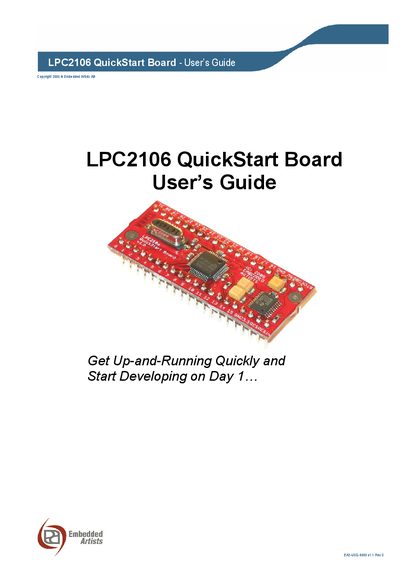
This guide introduces the Embedded Artists LPC2106 QuickStart Board, a low‑cost development platform based on the Philips ARM7TDMI LPC2106 microcontroller. It explains the board’s features, required power supplies, and the accessories included in the package.
The document covers board schematics, mechanical dimensions, programming methods (ISP and JTAG), and the contents of the accompanying CD‑ROM. It also provides information on product registration, available development environments, and references to additional datasheets and manuals.
| Microcontroller Flash | 128 Kbyte |
|---|---|
| Microcontroller SRAM | 64 Kbyte |
| Power supply voltage | 4‑6 VDC, ≥150 mA |
| External +3.3 V output | up to 300 mA |
| Crystal frequency | 14.7456 MHz |
| Board dimensions | 21.5 mm × 53.25 mm |
| Connector type | DIL 2×20 pins |
The board needs a 4 V to 6 V DC supply capable of providing at least 150 mA.
Use the serial ISP interface with tools such as the Philips LPC2000 Flash Utility or LPC21ISP.
The CD‑ROM contains a test program (source and HEX), ISP download programs, datasheets, the QuickStart Build Environment, and several development environments (CrossWorks, AR Embedded Workbench, GCC, Programmers Notepad, Eclipse).
It uses the Philips ARM7TDMI LPC2106 microcontroller.