
This article introduces three key steps to select the right fan or blower, including determining the total cooling requirements, calculating system resistance, and identifying the system operating point. It also mentions the objectives to consider when selecting the right air moving device, such as optimizing airflow efficiency, minimizing size and fit, reducing acoustic disturbance, minimizing power consumption, maximizing reliability and service life, and justifying the total cost.
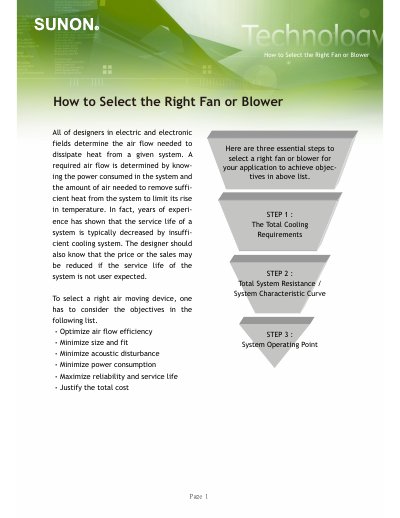
The document outlines three essential steps for selecting a fan or blower: determining total cooling requirements, analyzing system resistance and characteristic curves, and finding the system operating point where the fan performance curve meets the system curve. It also provides design considerations such as keeping airflow paths unobstructed, guiding vertical airflow, and accounting for filter resistance.
Practical examples illustrate how to match SUNON DC cooling fans of various sizes (e.g., 60×60×25 mm, 40×40×6 mm) to specific airflow and pressure drop requirements, helping designers select the most efficient fan or blower for their applications.
| Fan size (example) | 60 × 60 × 25 mm |
|---|---|
| Fan size (example) | 40 × 40 × 6 mm |
Three steps are required: total cooling requirements, total system resistance/characteristic curve, and system operating point.
Objectives include optimizing airflow efficiency, minimizing size and acoustic disturbance, reducing power consumption, maximizing reliability, and justifying total cost.