
Helieon is the first plug-and-play sustainable solid-state lighting module that integrates high-efficiency precision lighting with an easy-to-use socketed solution to accelerate innovation and enable the mass adoption of solid-state lighting.
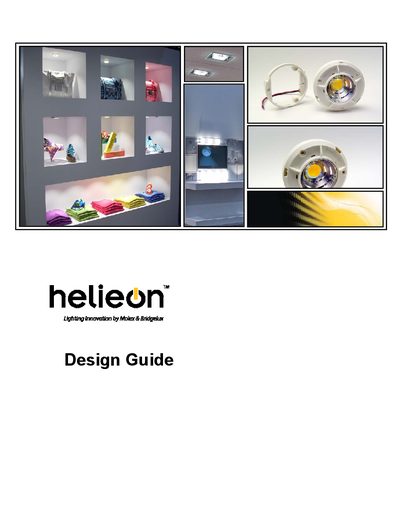
The Helieon Design Guide explains how to select and design interchangeable solid‑state lighting modules. It covers module selection, thermal management, electrical management, optical management, and assembly procedures, helping designers create reliable luminaires.
Key sections include detailed heat‑sink sizing rules, driver selection criteria, photometric data for different beam angles, and step‑by‑step instructions for measuring case temperature with a thermocouple or probe. Appendices list product ratings and performance curves for alternative drive currents.
| Supported drive currents | 700 mA, 1050 mA, 1400 mA (and other currents per performance curves) |
|---|---|
| Heat‑sink surface‑area guideline | 10 sq in per 1 W of dissipated power |
| Thermocouple type for case temperature measurement | 36‑gauge or smaller K‑type thermocouple |
Helieon modules are rated for 700 mA, 1050 mA, and 1400 mA, and can also be driven at other currents as shown in the performance curves.
A well‑ventilated aluminum heat sink should provide about 10 square inches of surface area for each watt of power dissipated.